Monday, 26 April 2010

PIMP MY iPHONE: Our Top Ten Applications

Everyone knows that when you get an iPhone it becomes NUMBER 1. Suddenly you can't live without the Wiki application and you enter some kind of Tfl paralysis without the Apple tube map. Soo let's play Pimp my iPhone.

1.Lightsaber: Obviously your number 1 essential iPhone item. Swing your iphone around and relive all your Obi wan Kenobi fantasies.

2.Spotify: It makes iTunes obsolete.

3.TIME magazine: The news in a slide show. Who needs Krishnan Guru-Murthy anyways?

4.Evernote: This allows students to make quick notes in class or in the library. It supports not only text but also photos and lets you access your notes anywhere. This makes it into our top ten for sheer uselessness- since when have you ever been allowed to use your phone so blatanly in a class?

5. Shazam: When you try to remember the tune, lyrics and name of that song you really like but can't remember any of them use Shazam to identify it. Next time it comes on just hold your iPhone to the song. If it was that good a song you'd probably remember it anyways but just in case you don't...

6.Run Keeper: It tells you how many calories you've burnt while running. Downside-you have to run.

7.METRO: Reduce your Metro footprint by downloading the paper to your iPhone before you get on the train. Also reading it on your phone means it takes up less room when the train is already fricken crowded.

8.Mint: Budgets your life for you. It checks your cashflow and gives you alerts like "You've spent too much money on parking." Tell me something I don't know...in crazy cool colour-coded barcharts.

9.Red Laser: It's like a Tesco do-it-yourself checkout but more efficient and more fun. Tells you how much everything costs, where to get it cheaper and lots of online information about that product.

10.Tube Exits: This tells you where the exits on platforms are so you know where to stand on the train. You don't need the internet to support this so you can get all the info whilst still nestled under the token fatman's armpit.

We said ten but honestly the list goes on. If you're feeling particularly touchscreen happy we also recommend Chanel,Whats App, Vocab Daily, Bump, Guardian, Convert Units and Around Me. Oh oh oh and an iPhone is never complete without BUBBLEWRAP but we are assuming you've already got that.

Monday, 8 March 2010

Sergei Paradjanov at the BFI-'The Colour of Pomegranates' Reviewed


This month BFI Southbank are presenting the first-ever full retrospective of Paradjanov's films. 1968 experimental flick The Colour of Pomegranates tells the (completely fabricated) story of an 18th century Armenian poet known as Sayat Nova, king of song. The dream-like imagery of this unlikely biopic-we're talking churches full of sheep, monks sucking pomegranates in synchronicity, Christ-like figures on monastery roofs- is weaved together in a Paradjanov patchwork of life,love and loss. You'll be glad to know, however, that all the surreal arty weird shit that goes on is not an attempt to recreate what happened to Sayat Nova. Rather, it is an attempt to recreate the imaginative and powerful inner life of the poet as he faced the various crises of his life.

Banned by the Soviets, the film first hit international screens during a campaign to release the director from labour camp where he had been jailed by the Russian authorities. However, this wasn't the dissedent's first stint in the Soviet jailhouse. In 1848 he was arrested for homosexual acts with a KGB officer. Film historian Tony Rayns, introducing the controversial director's work at the BFI, tells us that at a New York film festival Paradjanov sat next to Alan Ginsberg while The Colour of Pomegranates was on, pointing to the screen every five minutes saying "I had that one, and that one and that one and that one." On that slightly uncomfortable note, we think you should go and see some of the people he did at the BFI throughout this season.

Wednesday, 10 February 2010

BOOK REVIEW: The Chapel at the Edge of the World, Kirsten McKenzie

Lamb Holm, one of the many isolated islands of the Orkney archipelago, may have a population of approximately three sheep but it was once home to five hundred Italian POWs. Captured in North Africa during the Second World War, they were sent to work on the construction of four Scottish causeways known as the Churchill Barriers. However, the prisoners soon became tired of assembling glorified chicken crossings and in their desire to create something more meaningful, built an Italian chapel from a disused wartime bunker. It is around this poetic historical framework that McKenzie weaves a narrative of hope and human perseverance with the chapel at its beating heart.

Although at times McKenzie lays on the religious symbolism a little too heavily, her debut novel comes into its own with its subtle treatment of everyday struggles. While imprisoned protagonist Emilio engages in daily battles with the Scottish climate and pompous British officials, his childhood sweetheart, Rosa, is left on the Italian Home Front fighting not only Nazi control but her feelings for Pietro, a dangerous member of the resistance movement. Kirsten McKenzie flits lightly and skilfully between Orkney and Italy, and between the strands of her story of war-torn love, which she tells with sensitivity and colour. All in all, she will have you booking your ticket to the Chapel before you have even finished the book and quite frankly, Lamb Holm could do with the occasional visitor.

It's all about Amazon- you can get The Chapel at the Edge of the World for £9. You know you want to add it to your basket and PayPal it.

Thursday, 28 January 2010

Jesus Christ! Mel Gibson’s got a new film: Edge of Darkness reviewed


Resurrected as a Boston police detective, Mel Gibson returns to the screen as a single father and honest citizen seeking retribution for his child’s murder on the doorstep of his own home. So far, so Patriot but this Martin Campbell thriller quickly takes a political turn. Based on the 1980s BBC miniseries , the Cold War origins of this Edge of Darkness reworking become palpable as Craven (Mel Gibson) goes about exposing a ‘nuclear waste facility’ for what it actually is in his radioactive quest for revenge.

As he slowly transforms into what basically a UN weapons inspector with 'nothing to lose' but plenty of ammunition, the aesthetic becomes increasingly stylised despite the director’s claims to ‘realism’. As if most people stumble around with a trenchcoat, a loaded gun and a frenetic Geiger counter after they’ve been poisoned, radioactively that is. Previous to this transition, he spends his time moping about his daughter and hearing voices in a pathetic attempt to be emotive. Otherwise, it looks good, it builds tension well but at its core is just another one of Mel's angry American dad films with Ray Winstone, raincoats and radioactivity thrown in for js.

It's out tomorrow guys. We give it a 5/10 on the Geiger counter.MK

Thursday, 21 January 2010

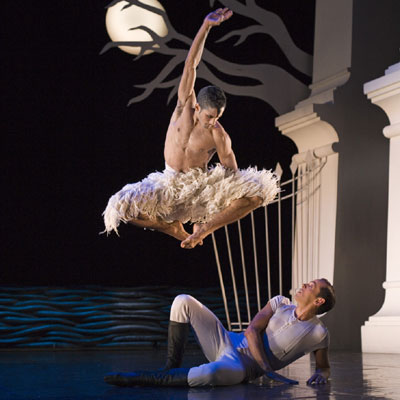
MAN SWANS: Matthew Bourne’s Swan Lake reviewed

Contrary to dance pleb belief, Matthew Bourne’s Swan Lake is not a ballet. First staged in Sadler’s Wells in 1995, this controversial contemporary dance has returned to its original stage as the longest running dance show in the West End.

It’s been 14 years since Matthew Bourne said goodbye to tutus, pointe shoes and ballet convention to choreograph a version of Swan Lake with male swans. However, the homoerotic undertones of the revised plot rattled the feathers of some early audience members. Some critics complained about its departure from traditional ballet while one girl from the local ballet school cried because it was distinctly lacking in the big white tutu department.

Over the years the male dancers have become iconic so their virile masculine physicality and their famous frayed trousers designed by Lez Brotherston which appeared at the end of Billy Elliot the movie are to be expected. However, what catches you off-guard is the intensity of the encounter between the Prince and the swans. The whole thing is delivered with such emotion. And not the faux opera house emotion of the heavily made-up Royal prima ballerinas either.

From the tormented Prince to his hilarious girlfriend, who, in a clever piece of satire eats Maltesers in a theatre, are surprisingly real. It has a kind of immediacy that makes it utterly unique in the world of dance. In fact, its key critique of traditional dance performances is that they lack any kind of relation to the lives of the audience, most sharply carried out in the theatre scene. A ridiculous parody of pretentious ballets it involves all of the animal kingdom dancing with exaggerated emotion and a devil who has some absurd piece of artwork dangling distractingly from his crotch- sound familiar?

The novelty of this production and the controversy surrounding it might have attracted dance-lovers in the nineties but controversy isn’t what keeps the audiences coming. In its fifteenth year it's just as funny, just as sad and just as relevant as it used to be. They certainly don’t call it a contemporary dance for nothing.

Vicarious says go see this or we're not your friend anymore.MK